How to Remove a Defamatory Article From Google
A defamatory article appearing in Google search results can damage your reputation before you even have a chance to explain your side of the story. The potential customers, employers, and other partners may come across the article and make an unjustified judgment based on the misleading, incorrect, or defamatory information. To know how to remove the defamatory article from Google is very crucial.
The good thing is that you do have alternatives available. You can try for the removal of the defamatory article from Google either by requesting it from the publisher or through Google itself or using professional content removal service. Although there is no assurance of the removal of the article, you do have options available.
Table of Contents
- What Is a Defamatory Article?
- How to Remove a Defamatory Article From Google
- When Can Google Remove a Defamatory Article?
- What If the Publisher Refuses to Remove the Article?
- Can You Push Down Negative Search Results?
- When Should You Consider Professional Help?
- Protect Your Reputation Before the Damage Spreads
What Is a Defamatory Article?
Defamatory articles include untrue statements made to look like facts that are capable of damaging someone’s or some business’ reputation. For instance, an article written online may make false claims about the business practices of a company or the professional behavior of an executive.
Nonetheless, all negative articles do not necessarily constitute defamation. In some cases, the publication may actually be reporting truthfully, stating an opinion or making valid criticisms and hence may be protected by law. This is important since it means the course of action to take will depend on the nature of the article, whether its contents are true or false and how they were published.
The repercussions of negative information being visible in the search engine may go further than just the article itself.
How to Remove a Defamatory Article From Google
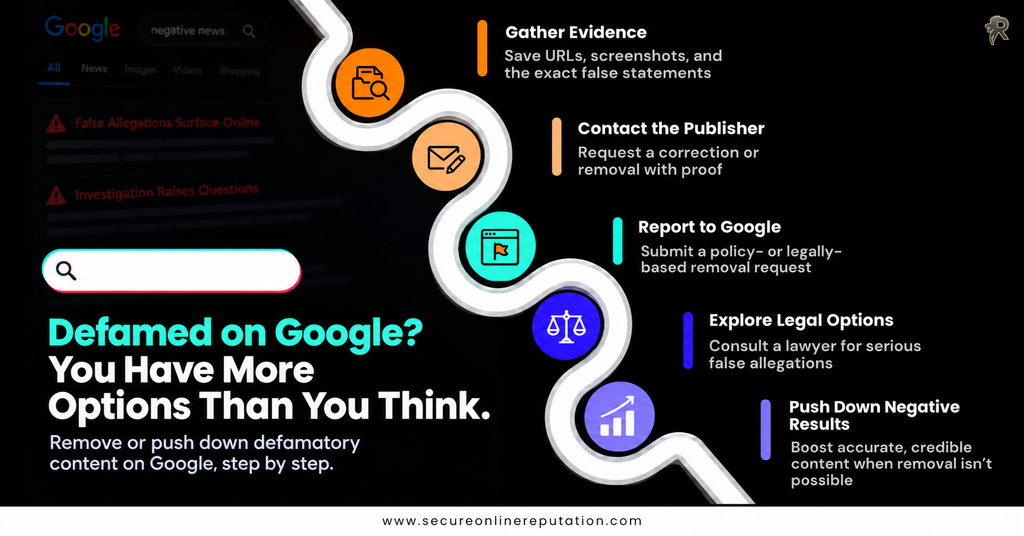
In case you want to know about the removal of an article that can be defamatory for you on Google, the first step will be to find out what caused the problem. Google shows links to pages that are created by other sites.
1. Collect Evidence of the Defamatory Content
Start by saving the article URL, screenshots, publication date, and the exact statements you believe are false. Keep any documents, emails, records, or other evidence that may help establish the facts.
Documenting the issue creates a clear record of the damage and helps you prepare a more effective removal request. Avoid making public accusations against the publisher before reviewing the facts carefully.
2. Contact the Publisher Directly
In many cases, approaching the website owner or editor is a sensible first step. Explain which statements are inaccurate, provide supporting evidence, and request a correction, removal, or appropriate update.
Keep your communication professional and specific. A request that identifies the exact passage and explains why it is disputed is generally more useful than a broad demand to delete the entire article.
If the publication agrees to remove or correct the content, ask for confirmation. You can then check whether the updated page is reflected in Google search results.
3. Submit a Removal Request to Google
Google provides processes for reporting certain content that violates its policies or qualifies under applicable legal requirements. Review the relevant policy and submit the appropriate request with the URL and supporting details.
Google does not automatically remove every article that someone considers defamatory. A complaint may be reviewed under the applicable rules, and the outcome depends on the nature of the content and the evidence provided.
Even when Google removes a link from eligible search results, the article may remain accessible directly on the publisher’s website. Therefore, requesting removal from Google and seeking removal from the original source may need to happen separately.
4. Consider Legal Options When Appropriate
If the article contains serious false allegations, consider consulting a qualified lawyer in the relevant jurisdiction. A legal professional can assess whether the statements may constitute defamation and advise you on the available remedies.
Depending on the circumstances, options may include a formal correction request, a legal notice, negotiations with the publisher, or court proceedings. Avoid assuming that every negative statement meets the legal definition of defamation.
Taking a careful, evidence-based approach can help you choose a response that protects your interests without escalating the situation unnecessarily.
When Can Google Remove a Defamatory Article?
Google may remove certain content when it meets applicable legal requirements or violates its policies. However, a request based solely on the fact that an article is damaging to your reputation may not be sufficient.
The circumstances that deserve closer examination include demonstrably false allegations, content that violates relevant platform policies, and material subject to a valid legal removal requirement.
If you want to remove negative news from Google, remember that the platform evaluates requests according to its applicable rules. It is important to identify the specific reason for removal and provide accurate supporting information.
A rejected request does not necessarily mean you have no other options. You may still be able to contact the publisher, seek legal advice, pursue a correction, or work on improving the quality and visibility of other search results.
What If the Publisher Refuses to Remove the Article?
A publisher may refuse to remove an article, particularly if it believes the material is accurate or protected by applicable law. When that happens, consider your next steps carefully rather than repeatedly sending the same request.
First, review the publisher’s response and identify whether it addresses the disputed statements. If you have new evidence, submit a more focused request. Where appropriate, consider independent legal advice or a complaint through a relevant regulatory or platform process.
You can also explore negative content removal strategies that address the wider search results associated with your name or business.
The goal is to develop a practical response based on the available evidence. In some situations, correction or removal may be possible. In others, managing the visibility of the article may be the more realistic option.
Can You Push Down Negative Search Results?
When an article cannot be removed, improving the visibility of accurate and relevant information can help reduce its prominence in search results. This approach is often part of online reputation management.
For example, you can publish useful content on your professional website, update your biography, strengthen your business profiles, and contribute meaningful articles to reputable publications. These efforts can help search engines discover more relevant information about you.
The objective is not to mislead people or manufacture a false image. Instead, it is to make credible, current, and useful information easier to find.
A well-planned strategy may include:
- Publishing original articles that demonstrate your expertise.
- Updating professional profiles with accurate information.
- Improving existing website pages through useful content and sound SEO practices.
- Building legitimate mentions and links from relevant, reputable sources.
- Monitoring search results to understand whether your efforts are improving visibility.
Although these activities cannot guarantee that a negative article will disappear from the first page, they can support a broader effort to repair your online reputation.
When Should You Consider Professional Help?
Handling a defamatory article can become complicated when multiple websites republish the same allegations or when the content continues to appear prominently in search results.
Professional online reputation specialists can review the situation, identify possible removal routes, help organize supporting evidence, and develop a search visibility strategy. Depending on the case, their work may involve publisher outreach, policy-based reporting, content removal assessments, and search engine : optimization.
Before choosing a provider, ask what actions it recommends, what results are realistically achievable, and how progress will be measured. Be cautious of anyone promising guaranteed removal from Google or claiming to have special access to search engine systems.
The right approach should be transparent, evidence-based, and tailored to the specific article and circumstances.
Protect Your Reputation Before the Damage Spreads
While a harmful article can cause confusion and mistrust, failing to address the issue may allow the story to stay visible for a longer period of time. Acting fast will enable you to become aware of the choices at hand.
When determining what to do to have a libelous article taken down from Google, start from the facts: gather evidence, approach the publisher, look into Google’s relevant policies for take down, and seek legal help where needed. In case it is impossible to remove the content, work on making good information more visible.
Reputation takes time to build, and preserving it requires deliberate action. With a proper plan, you can start working on setting the record straight and minimizing unnecessary damage.
Conclusion:
A defamatory article can leave a lasting impact on your personal or professional reputation, especially when it appears prominently in Google search results. However, the right approach can help you address the issue and protect your credibility. Understanding how to remove a defamatory article from Google allows you to explore practical options, from contacting the publisher and submitting a removal request to seeking legal advice when necessary.
If removing the original article is not possible, improving the visibility of accurate and trustworthy information can help reduce its prominence. With a strategic approach to content removal and online reputation management, you can take meaningful steps towards restoring trust and building a stronger digital presence. Don’t let damaging information define your story take action today to protect your reputation.
Also visit this- Why Customers Believe Strangers Reviews More Than Your Brand Promises