How to Remove Negative Content From Google: Deleting Bad Reviews, Social Media Posts, and Unwanted Profiles
A single out-of-context post or one malicious fake review can damage your reputation before you get a chance to explain your side. Potential customers, investors, and employers research you online before making a decision, and when negative content ranks at the top of Google, it hurts your credibility instantly. Knowing how to remove negative content from Google is therefore crucial. The good news is that you have options when it comes to removing negative content from Google. You can request removal from the platform or the person who posted the content, report it under the platform’s policies, take legal steps where appropriate, or work with a professional content removal service. Removal is never guaranteed, but a clear process gives you the best chance.
Table of Contents
- What Is Negative Content in Google Search Results?
- How to Remove Negative Content From Google and Other Platforms
- When Can Negative Content Be Removed From Google?
- What If Google or the Publisher Refuses to Remove It?
- Can You Push Down Negative Search Results?
- When Should You Consider Professional Help?
- Protect Your Reputation Before the Damage Spreads
What Is Negative Content in Google Search Results?
Negative content includes false, misleading, or unfairly harmful statements, reviews, posts, videos, or profiles that can hurt a person’s or a business’s reputation. Examples include a fake review from someone who was never a customer, a post that makes false claims about a company’s practices, or an outdated listing for a business that has closed.
However, not every negative item is a violation. A genuine but critical review, an honest opinion, or a truthful account may be allowed to stay under platform rules and the law. The right course of action depends on who published the content, whether it is true or false, and which rules it breaks.
The effect also reaches beyond the item itself. Review platforms and social networks carry high domain authority, so their pages often rank near the top of search results for your name or brand.
How to Remove Negative Content From Google and Other Platforms
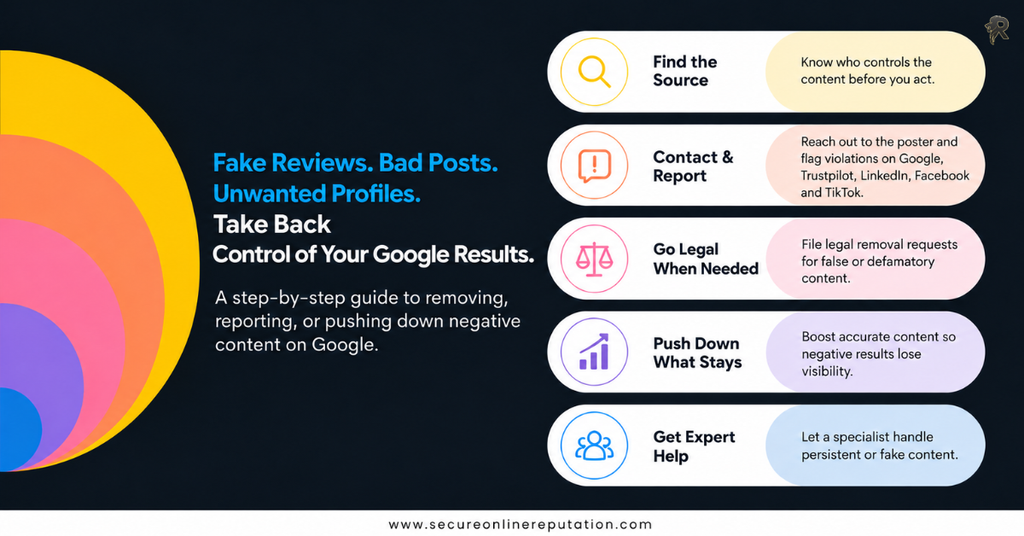
To remove negative content from Google, the first step is to identify where the content lives and who controls it. Google only links to pages hosted elsewhere, so removal usually starts with the platform or the person who posted it.
1. Collect Evidence
Save the URL, screenshots, the date, and the exact statements you believe are false or against the rules. For reviews, keep order records, emails, and customer-service logs that show the reviewer has no genuine history with you. Avoid responding with public accusations before you have reviewed the facts.
2. Contact the Poster or Publisher Directly
A polite, specific request is often the fastest route. Explain which statements are inaccurate, provide evidence, and ask for a correction or removal. For customer complaints, resolving the underlying issue may lead the reviewer to update or delete the review voluntarily. If they agree, ask for confirmation and check that the change shows up in search results.
3. Report the Content on the Platform
Each platform has its own process, summarized below.
| Platform | Target Content | Outcome & Considerations |
| Trustpilot | Inactive or duplicate profile | Permanent removal upon proving official business closure or merging duplicate pages. |
| Fake, defamatory, or policy-violating review | Full removal when content violates prohibited content guidelines or legal standards. | |
| Unwanted personal or corporate post | Direct deletion for owned content; takedown via privacy or copyright reports for third-party posts. | |
| Outdated or inaccurate post | Instant removal from personal feeds; removal from groups via admin request or policy reporting. | |
| TikTok | Harmful or infringing video | Deletion via account manager; platform takedown for copyright or privacy violations. |
Trustpilot: Trustpilot treats open feedback as a consumer right, so you cannot delete an active business page just because of bad ratings. Deleting a personal or business user account removes your personal data and the feedback you posted, in line with privacy rules such as GDPR and CCPA. A listing can be removed if the business has officially closed, if duplicate profiles are merged, or if individual reviews break the guidelines and the challenge succeeds.
Google Business Profile: You cannot instantly delete a review written by a third party, but you can flag it. Reviews that are fake, come from competitors or former employees with a conflict of interest, or amount to harassment can be reported through your profile. If the first report is declined, you can appeal with additional evidence.
LinkedIn: You can delete your own posts at any time. For a post by someone else that targets you or your business, file a harassment or privacy report, or a copyright claim if your original material was used.
Facebook: You can delete outdated posts on your own profile or Page using history filters and Page tools. For content in a public group or on a third-party Page, ask the admin to remove it, report it under community standards, or file an intellectual property take down notice.
TikTok. Account owners can delete their own videos through the video management menu. For defamatory or privacy-violating videos posted by others, report them to TikTok for copyright, trademark, harassment, or privacy violations.
4. Consider Legal Options When Appropriate
If content makes serious false allegations, consult a qualified lawyer in the relevant jurisdiction. A lawyer can assess whether the statements amount to defamation and advise on remedies, which may include a formal correction request, a legal notice, negotiation, or court proceedings. Platforms such as Google also accept legal removal requests for defamatory reviews, though outcomes vary by country and evidence. Avoid assuming that every negative statement meets the legal definition of defamation.
When Can Negative Content Be Removed From Google?
Google and other platforms remove negative content when it breaks their own policies or meets a legal requirement. A request based only on the fact that a review or post is damaging to your reputation is usually not enough.
The cases that deserve a closer look include:
- Fake or spam reviews, including those from people who never used your service.
- Conflicts of interest, such as reviews from competitors or disgruntled former employees.
- Harassment, hate speech, threats, or the exposure of personal information.
- Content that infringes your copyright or trademark.
- Inactive or duplicate business profiles.
- Material that is demonstrably false and subject to a valid legal removal request.
Identify the specific rule the content breaks and support your report with accurate evidence. Even when a platform removes an item, copies may still exist elsewhere, so removal from the platform and removal from search results may need to be handled separately.
What If Google or the Publisher Refuses to Remove It?
A refusal does not necessarily mean the end of the road. Platforms and posters may decline if they believe the content is genuine, honest opinion, or permitted under their rules. Rather than resending the same request, review the response and see whether it addresses the disputed statements.
Consider these next steps:
- Submit a more focused appeal with new evidence, such as transaction records that show the reviewer was never a customer.
- Reply publicly to genuine complaints in a calm, professional tone. Future readers often judge you by how you respond.
- Seek independent legal advice where the content may be defamatory.
- Use privacy or data-protection routes where personal information is involved, including search engine tools that let you request removal of certain personal details from results.
In some situations, correction or removal is possible. In others, managing how visible the content is may be the more realistic option.
Can You Push Down Negative Search Results?
When content cannot be removed, improving the visibility of accurate and relevant information can reduce its prominence. This approach is a core part of online reputation management.
The objective is not to mislead anyone or manufacture a false image. It is to make credible, current, and useful information easier to find. A well-planned strategy may include:
- Keeping your website, business listings, and professional profiles accurate and up to date.
- Publishing original articles that demonstrate your expertise.
- Asking satisfied customers to share genuine reviews so that authentic feedback builds over time.
- Earning legitimate mentions and links from relevant, reputable sources.
- Monitoring search results and setting alerts for your name and brand.
These steps cannot guarantee that a negative result will leave the first page, but they can support a broader effort to repair your reputation.
Avoid common mistakes along the way. Arguing publicly with a reviewer draws more attention to the content, buying or posting fake reviews violates platform rules and may breach consumer-protection law, and filing false reports can get your own account or listing restricted.
When Should You Consider Professional Help?
The process becomes complicated when several sites repeat the same allegations, when platform appeals keep getting rejected, or when the content continues to rank prominently. Each network has its own rules, timelines, and appeal procedures, and a poorly submitted request can slow things down.
Online reputation specialists can review your situation, identify possible ways to remove negative content from Google, organize supporting evidence, and build a search visibility plan. Depending on the case, their work may involve outreach, policy-based reporting, content removal assessments, and search engine optimization.
Before choosing a provider, ask what actions it recommends, what results are realistically achievable, and how progress will be measured. Be cautious of anyone who promises guaranteed removal or claims to have special access to platform or search engine systems. The right approach is transparent, evidence-based, and tailored to your circumstances.
Protect Your Reputation Before the Damage Spreads
Leaving a harmful review, post, or video unaddressed can allow it to stay visible, and gain search authority, for longer. Acting early gives you more choices.
Start with the facts. Audit what appears when you search for your name and business, gather evidence, contact the poster, report the content under the right platform policy, and seek legal help where needed. Delete content you own and no longer want visible. If removal is not possible, focus on making accurate information more visible.
Reputation takes time to build, and protecting it takes deliberate action. With a clear plan, you can start setting the record straight and limiting unnecessary damage.
Conclusion
Negative reviews, outdated posts, and unwanted profiles can have a lasting effect on your personal or professional reputation, especially when they rank prominently on Google. Knowing how to remove negative content from Google starts with understanding the removal routes on Trustpilot, Google, LinkedIn, Facebook, and TikTok. That knowledge lets you take practical steps, from contacting the poster and reporting policy violations to seeking legal advice when necessary.
If removal is not possible, improving the visibility of accurate and trustworthy information can reduce the prominence of damaging content. With a strategic approach to content removal and online reputation management, you can restore trust and build a stronger digital presence. Don’t let damaging content define your story. Take action today to protect your reputation.
If you are dealing with persistent negative content, fake reviews, or unauthorized posts that won’t go away, you don’t have to tackle it alone. Our team can help you remove negative content from Google, challenge unfair review profiles, and protect your online brand identity.
Reach out to our specialists today:
📧 Contact: [email protected]