The Online Reputation Gap: Why People Trust Google Search Results More Than Your Ads
Google Search Results and AI overview have become one of the most powerful influences on customer trust. Businesses spend thousands of dollars on advertising every year, but many consumers still turn to Google before making a purchase decision.
Modern consumers not only demand information but also expect verification. Before selecting any business, they will study reviews, consider competition, search for news, and review customer feedback. This new attitude among consumers has given rise to what many professionals refer to as the online reputation gap: the gap between self-representation and online perception.
In today’s world, knowledge of online reputation gaps is critical for every business. Those organizations that have managed to win trust with their visibility and credibility perform better than the others.
Table of Contents
- What Is Online Reputation Gap?
- Why Google Search Results Matter More Than Advertising
- How Google Search Results Influence Customer Trust
- The Role of Reviews in Google Search Results
- Negative Content and Consumer Perception
- Why Reputation Matters More Than Ever
- How Businesses Can Close the Reputation Gap
- Business Reputation Repair as a Long-Term Strategy
What Is Online Reputation Gap?
The online reputation gap is the difference between a company’s marketing message and the perception customers develop through independent research.
Advertising helps businesses control their message. Search engines do not. When consumers search online, they gain access to reviews, ratings, articles, social media discussions, and other third-party content.
Because this information comes from multiple sources, people often trust it more than paid advertisements.
When customers find positive and consistent information, confidence increases. When they find criticism or conflicting information, trust begins to decline.
This is why Google Search Results have become such an important part of the buying process.
Why Google Search Results Matter More Than Advertising
Consumers are more informed today than ever before. They rarely make decisions based on advertisements alone.
Instead, they use search engines to verify claims and gather additional information.
Google Search Results Provide Social Proof
People trust the experiences of other customers. Positive reviews and testimonials show that a business delivers value.
A company may claim to offer excellent service, but consumers want confirmation from real people. Reviews provide that confirmation. As a result, Google Search Results often carry more weight than advertising campaigns.
Google Search Results Create Transparency
Consumers appreciate transparency. Search engines give them access to different opinions and experiences.
Rather than relying on one message from a business, customers can evaluate information from multiple sources. This ability to compare information creates trust and confidence.
Independent Research Feels More Credible
People tend to trust information they discover for themselves. A recommendation from a review platform or industry publication often feels more authentic than a promotional advertisement.
This is one reason Google Search Results frequently influence purchase decisions more than marketing campaigns do.
How Google Search Results Influence Customer Trust
Trust is one of the most valuable assets a business can have.
When consumers search for a brand, they often form an opinion within minutes. They review ratings, customer comments, news mentions, and website content before deciding whether to engage.
Strong Google Search Results can reinforce credibility and support marketing efforts. Weak search visibility can create doubt, even when advertising campaigns are effective.
This connection between visibility and trust explains why many businesses invest heavily in online reputation management.
By actively monitoring their digital presence, companies can ensure that customers see accurate and positive information.
The Role of Reviews in Google Search Results
Online reviews have become a major factor in consumer decision-making.
Many buyers read several reviews before making a purchase. They want to understand how a company treats customers and handles challenges.
A business with hundreds of positive reviews often appears more trustworthy than a competitor with limited customer feedback.
Positive reviews strengthen Google Search Results and improve customer confidence. Negative reviews can have the opposite effect.
For this reason, review management has become a core component of effective online reputation management.
Negative Content and Consumer Perception
Negative content can significantly influence how consumers view a business.
A critical review, customer complaint, or unfavorable article may appear in Google Search Results and shape public perception immediately.
People naturally pay attention to risks. Because of this behavior, negative information often attracts more attention than positive content.
Many organizations work to remove negative search results from prominent positions whenever possible. While not every piece of content can be removed, businesses can improve their online presence by publishing valuable content and earning positive mentions across the web.
These efforts help create a more balanced digital footprint and strengthen long-term credibility.
Why Online Reputation Matters More Than Ever
The customer journey has changed dramatically over the last decade.
Today, consumers can research companies in just a few minutes. They can compare services, evaluate reviews, and analyze brand credibility before contacting a business.
Because of this shift, Google Search Results now play a critical role in shaping buying decisions.
A strong online reputation can support marketing efforts, increase conversions, and improve customer loyalty.
Businesses that ignore their online presence often struggle to compete, regardless of how much they spend on advertising.
This is where online reputation management becomes a valuable business strategy rather than a marketing luxury.
How Businesses Can Close the Online Reputation Gap
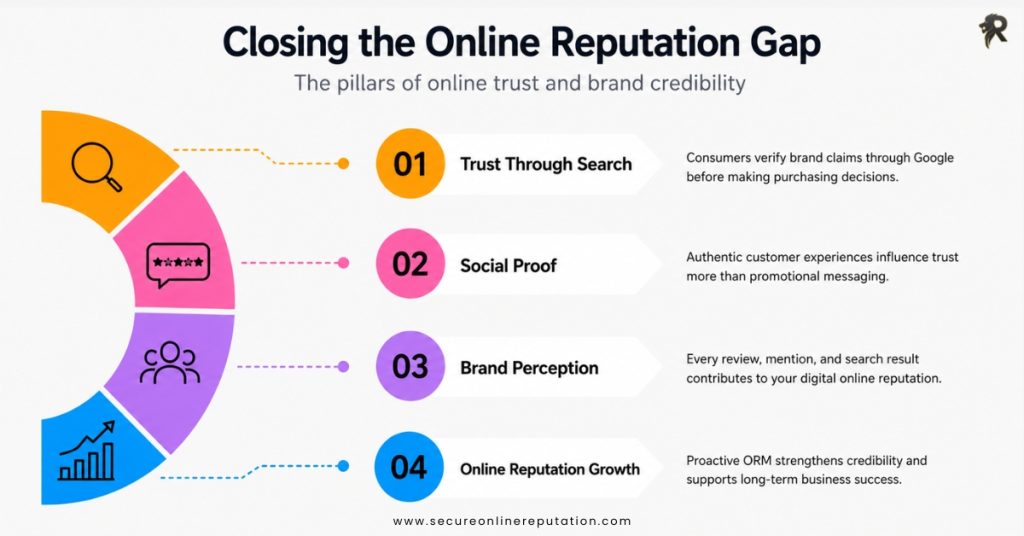
Closing the online reputation gap requires consistency, transparency, and ongoing effort.
Businesses can strengthen their reputation by:
- Monitoring Google Search Results regularly
- Encouraging satisfied customers to leave reviews
- Responding professionally to feedback
- Publishing helpful and authoritative content
- Addressing customer concerns quickly
- Maintaining a consistent brand message
These actions help businesses build trust and improve how they appear online.
Over time, positive search visibility supports stronger customer relationships and better business outcomes.
Business Reputation Repair as a Long-Term Strategy
Many businesses focus on reputation only when a problem occurs. However, online reputation management works best when approached proactively.
Effective business reputation repair is not a one-time project. It is an ongoing process that requires attention and consistency.
Every review, article, social media mention, and search result contributes to public perception.
Companies that invest in online reputation management before a crisis often recover faster when challenges arise. They also maintain stronger customer trust over time.
A well-managed reputation protects brand value and creates opportunities for long-term growth.
Conclusion
The reputation gap exists because consumers trust independent information more than advertising messages. Before making decisions, people rely on Google Search Results to evaluate credibility, compare options, and verify brand claims.
While advertising remains important for building awareness, trust comes from transparency, consistency, and positive customer experiences.
Businesses that invest in online reputation management, focus on business reputation repair, and take steps to remove negative search results are better positioned to earn customer confidence.
In today’s digital world, advertising may capture attention, but reputation is what drives trust. Companies that understand this difference will have a significant advantage in attracting customers and achieving sustainable growth.