What to Do When an Old News Article Damages Your Online Reputation
An old news article does not have to stay old news in the eyes of the people searching for you. Google does not forget easily, and a story from five years ago can sit right at the top of the page as if it happened yesterday. Whether it is a lawsuit that was settled long ago, a mistake you have grown past, or a report that was simply one-sided to begin with, the article keeps resurfacing every time someone types your name. This is exactly why so many people start searching for how to get a news article removed from the internet the moment they realize an old story is still shaping how they are seen today.
It helps to understand, right from the start, that an outdated article and a false article are not the same problem, and they do not call for the same solution.
Table of Contents
- Why Old News Still Hurts a Current Reputation
- Is Removal Actually Possible?
- How Suppression Works for Older Articles
- Steps to Push Down an Old Negative Story
- Building a Digital Presence That Reflects Who You Are Now
- When to Bring in Professional Help
- Keeping Watch So the Problem Doesn’t Return
1. Why Old News Still Hurts a Current Reputation
Search engines don’t apply an expiration date to content. An article published years back can rank exactly as strongly as something published last week, especially if the original site carries authority. For a business owner, that might mean a client-facing dispute from a previous decade still greets every new prospect who searches the company name. For a professional, it might mean an old headline overshadows years of legitimate growth.
The damage isn’t really about what happened. It’s about the gap between who you are now and what the search result implies about you. That gap is what makes so many people frustrated enough to look into online reputation management in the first place — not to hide the past, but to stop it from unfairly defining the present.
2. Is Removal Actually Possible?
This is usually the first question people ask, and the honest answer is: sometimes, but not always.
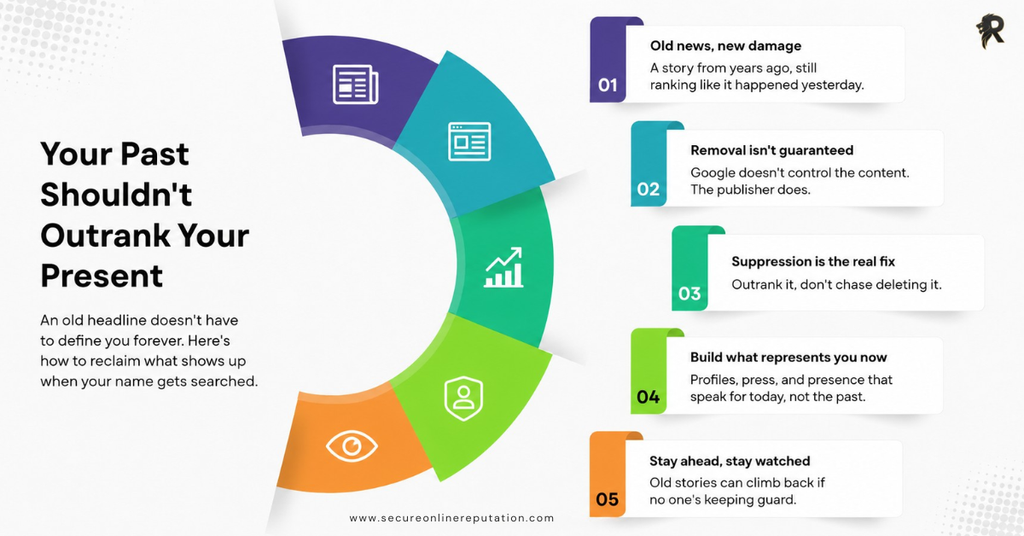
Google itself rarely controls the content — it only indexes it. The article lives on the publisher’s site, so any removal request generally has to go through them, not through search engine support. A publisher may agree to update or take down a piece if:
- The information was factually incorrect
- The article violates their own editorial or retraction policy
- There’s a legitimate legal basis, such as defamation or privacy law
- The content was tied to a record that has since been sealed or expunged
If none of those apply, and the article is simply old, unflattering, or inconvenient, a publisher is under no obligation to delete it. This is the reality most people run into when they first try removing news articles from google the story is accurate, so there’s nothing to formally contest, even if it no longer reflects who you are.
That’s the point where suppression becomes the realistic path forward.
3. How Suppression Works for Older Articles
Suppression doesn’t erase anything. It works by building up everything around the negative result until the negative result simply isn’t the first — or only — thing a person sees.
Think of a search results page as limited real estate. If an old article is occupying a top spot, the goal becomes filling the surrounding space with content that is more current, more relevant, and more representative of you today. Over time, as that content earns visibility, the old story naturally gets pushed further down the page.
This is slower than deletion, but it’s also far more within your control. You’re not depending on a publisher’s goodwill — you’re building something that belongs to you.
4. Steps to Push Down an Old Negative Story
There’s no single trick that moves a result overnight, but a consistent strategy tends to include:
- Owned platforms – an updated personal or company website that clearly represents your current work
- Professional and industry profiles – kept current, detailed, and consistent across platforms
- Original contributions – interviews, guest articles, commentary, or research that positions you as credible in your field today
- Business and press mentions – recent coverage that reflects present-day achievements
- Consistent naming and branding – so search engines associate the right signals with the right person or company
None of this works as a quick fix, and it shouldn’t be treated as one. A rushed pile of thin, repetitive pages tends to do more harm than good, both to how the strategy performs and to how genuine it looks to anyone who does eventually scroll past the old article.
5. Building a Digital Presence That Reflects Who You Are Now
Before creating anything new, it’s worth reviewing what already exists. Old bios, outdated company descriptions, inactive social profiles, and half-finished directory listings are missed opportunities — they could be working in your favor but currently aren’t.
Update what’s already there first. Then look for the honest gaps: Is there a clear, current picture of your work anywhere online? Would a stranger searching your name today find something that actually represents you? For companies handling a similar issue at a larger scale, this is often the starting point of a broader business reputation repair effort — not a single fix, but an ongoing alignment between what’s public and what’s true.
6. When to Bring in Professional Help
Some situations are manageable on your own — a single outdated article with low authority, paired with a reasonably active online presence, can often be outweighed with steady, patient effort.
Other situations are more complex: multiple articles, syndicated versions of the same story across several sites, a name that’s difficult to disambiguate from others, or a case where legal and search strategy need to work together. In those cases, working with an experienced team can save time and prevent missteps, since they’ll already know which approaches tend to work and which simply waste effort.
Whichever path you take, the underlying goal stays the same — not concealment, but balance.
7. Keeping Watch So the Problem Doesn’t Return
Reputation work doesn’t end once an old article moves off the first page. Search rankings shift, new content gets indexed, and an old story can quietly climb back up if nothing is actively maintaining the ground you’ve gained.
Set a routine of checking:
- Your name and any common variations of it
- Your business or brand name
- Key executive or team member names
- Related terms tied to the original story
Regular monitoring means you catch changes early, while they’re still easy to manage, rather than discovering months later that the old headline has resurfaced.
Final Thoughts
An old news article doesn’t have to define how you’re perceived today. It can’t always be deleted, but it can almost always be outweighed — by a stronger, more current, more accurate picture of who you are now. The work isn’t about erasing the past. It’s about making sure the past isn’t the only thing anyone finds.