Brand Reputation Management Strategies That Actually Work in 2026
Introduction
One negative review, a Reddit thread, or a poorly handled complaint can undo years of trust.
In 2026, reputation doesn’t decline slowly. It drops fast, publicly, and often without warning. Customers search before they decide. Investors research before they commit. Employers evaluate before they hire.
If what they find raises doubt, you lose more than attention. You lose revenue, opportunities, and long-term credibility.
This is why brand reputation management strategies are no longer optional. They are a core business function.
In this blog, I’ll walk you through what actually works today, what fails, and how to take control before your reputation becomes a liability.
What is Brand Reputation Management?
Brand reputation management is the process of shaping how your business is perceived online.
It includes monitoring what people say, responding strategically, and building a strong, credible digital presence that reflects reality.
There is often a gap between what your brand is and what people see online.
That gap is where risk lives.
In today’s digital-first environment, perception directly impacts business outcomes. According to the Edelman Trust Barometer, trust is a deciding factor in purchase decisions for a majority of consumers.
Reputation management bridges that gap by aligning visibility with truth.
Why Businesses Struggle with Negative Reputation
Most businesses don’t fail at reputation management because they don’t care. They fail because they react too late.
Here’s what typically goes wrong:
- Negative reviews dominate search results
- Social media escalations spiral quickly
- Competitor-driven narratives go unchecked
- There is no structured monitoring system
By the time leadership notices the issue, the narrative is already established.
Reputation today is not just a perception issue. It is a digital risk category that can impact valuation, compliance, and long-term growth.
10 Powerful Brand Reputation Management Strategies
1. Monitor Your Online Presence Continuously
You cannot manage what you don’t track.
Set up systems to monitor:
- Brand mentions
- Reviews across platforms
- News coverage
- Social conversations
The shift in 2026 is from reactive monitoring to predictive visibility. Businesses that track early signals respond before issues escalate.
2. Respond to Negative Feedback Professionally
Silence signals indifference.
A well-crafted response shows accountability and builds trust, even in difficult situations.
Avoid:
- Defensive tone
- Emotional replies
- Delayed responses
Customers don’t expect perfection. They expect responsibility.
3. Build and Promote Positive Content
Search results shape perception.
Publishing high-quality content such as:
- Thought leadership blogs
- Media features
- Industry insights
helps establish authority and push down negative noise.
This is not about hiding problems. It is about ensuring your full story is visible.
4. Fix the Root Cause
Reputation issues often reflect operational gaps.
If customers complain about:
- Poor service
- Delays
- Product issues
then content alone won’t fix it.
Strong reputation management aligns with actual business improvements.
5. Clean Up Online Reputation Strategically
Cleaning up your online reputation is a structured process.
It involves:
- Identifying harmful or outdated content
- Evaluating compliance with platform policies
- Taking appropriate action where applicable
- Building stronger, accurate narratives
As outlined, this step is critical for businesses dealing with sustained negative sentiment.
6. Strengthen Social Media Presence
Your social channels are your direct communication line.
Consistent engagement builds:
- Transparency
- Familiarity
- Trust
Inactive profiles create a vacuum where external narratives dominate.
7. Encourage Genuine Positive Reviews
Satisfied customers rarely leave reviews unless asked.
Create systems to:
- Request feedback
- Simplify review processes
- Follow up after positive interactions
Authentic reviews act as trust signals and influence decision-making.
8. Develop a Crisis Management Plan
Every business needs a response framework before a crisis happens.
This includes:
- Pre-approved messaging
- Internal escalation protocols
- Defined response timelines
Without preparation, response delays worsen the situation.
9. Use SEO to Control Search Visibility
Search is where reputation is validated.
Effective SEO ensures that:
- Positive, authoritative content ranks higher
- Brand-controlled narratives dominate page one
- Misleading or low-value content becomes less visible
This is not short-term optimization. It is long-term control of digital real estate.
10. Work with Reputation Management Experts
Managing reputation at scale requires:
- Technical expertise
- Legal understanding
- Strategic content execution
As highlighted in , modern reputation management is a unified system of SEO, PR, and legal precision, not isolated tactics.
How to Clean Up Online Reputation (Step-by-Step)
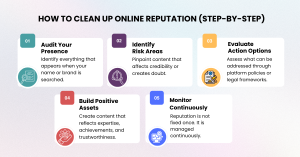
Here’s a practical framework:
Step 1: Audit Your Presence
Identify everything that appears when your name or brand is searched.
Step 2: Identify Risk Areas
Pinpoint content that affects credibility or creates doubt.
Step 3: Evaluate Action Options
Assess what can be addressed through platform policies or legal frameworks.
Step 4: Build Positive Assets
Create content that reflects expertise, achievements, and trustworthiness.
Step 5: Monitor Continuously
Reputation is not fixed once. It is managed continuously.
Common Mistakes Businesses Make
Many businesses unintentionally worsen their situation.
Key mistakes include:
- Ignoring negative feedback
- Attempting to delete criticism without strategy
- Responding emotionally
- Lacking a long-term plan
Short-term fixes rarely work. Reputation requires consistent, structured effort.
Real Business Impact of Poor Reputation
Reputation directly affects revenue.
Consider this:
- 93% of consumers read online reviews before making a purchase
- A one-star drop in rating can reduce revenue by up to 9%
- Negative search results reduce conversion rates significantly
There are real-world examples of companies losing millions due to public backlash, delayed responses, or unmanaged narratives.
Reputation is not abstract. It is measurable.
Why Trust and Authority Matter More in 2026
In today’s environment, trust is fragile.
According to global risk insights, misinformation and digital threats are among the top risks impacting businesses worldwide.
This means:
- Anyone can publish
- Narratives spread quickly
- Verification happens after damage
The only defense is proactive authority building.
That includes:
- Consistent visibility
- Credible content
- Transparent communication
Conclusion
Your reputation is your most valuable digital asset.
It influences:
- Customer decisions
- Investor confidence
- Business growth
And in 2026, it moves faster than ever.
The difference between brands that survive and those that struggle is simple.
One reacts. The other prepares.
If you are serious about growth, now is the time to implement strong brand reputation management strategies and take control of your narrative before someone else does.
FAQs
Q1. What are the best brand reputation management strategies?
Monitoring, proactive content creation, SEO control, customer engagement, and crisis planning are among the most effective strategies.
Q2. How can I clean up online reputation quickly?
Start with an audit, identify harmful content, take appropriate action, and build strong positive visibility.
Q3. Can negative content be removed from Google?
Certain content can be addressed through platform policies or legal processes, depending on compliance factors.
Q4. How long does reputation repair take?
It depends on the severity. Minor issues may take weeks, while larger cases require consistent effort over months.
Q5. Why is reputation management important for businesses?
Because reputation directly impacts trust, and trust drives revenue, partnerships, and long-term success