How to Handle a Sudden Increase in Negative Google Reviews and Remove Negative Search Results
A steady stream of five-star reviews can turn overnight. One bad experience gets posted, a few more follow, and suddenly your business profile looks nothing like the reputation you spent years building. When this happens, most owners react the same way: they start searching for how to remove negative search results tied to their business name before the damage spreads any further. It helps to slow down first. A sudden spike in negative reviews is rarely random, and the way you respond in the first few days often matters more than the reviews themselves.
Table of Contents
- Why Negative Reviews Suddenly Spike
- Is It a Real Problem or a Coordinated Attack?
- How to Remove Negative Search Results the Right Way
- What to Do When You Can’t Remove Negative Search Results Through Reporting Alone
- Responding to Reviews Without Making Things Worse
- Rebuilding Trust After the Spike
- When to Bring in Professional Help
- Staying Ahead So It Doesn’t Happen Again
1. Why Negative Reviews Suddenly Spike
A cluster of bad reviews arriving close together usually has a cause, even if it isn’t obvious at first. It could be a genuine service failure that affected several customers at once, a viral social media post pointing people to your listing, a disgruntled former employee, or in some cases, a competitor exploiting Google’s open review system. Understanding the source matters, because the fix for a real service issue is very different from the fix for a coordinated pile-on. Whatever the cause, the outcome is the same on the surface: your star rating drops, and anyone searching your business name sees the worst version of you first. That’s usually the moment business owners start looking into how to remove negative search results and general online reputation management to get ahead of it.
2. Is It a Real Problem or a Coordinated Attack?
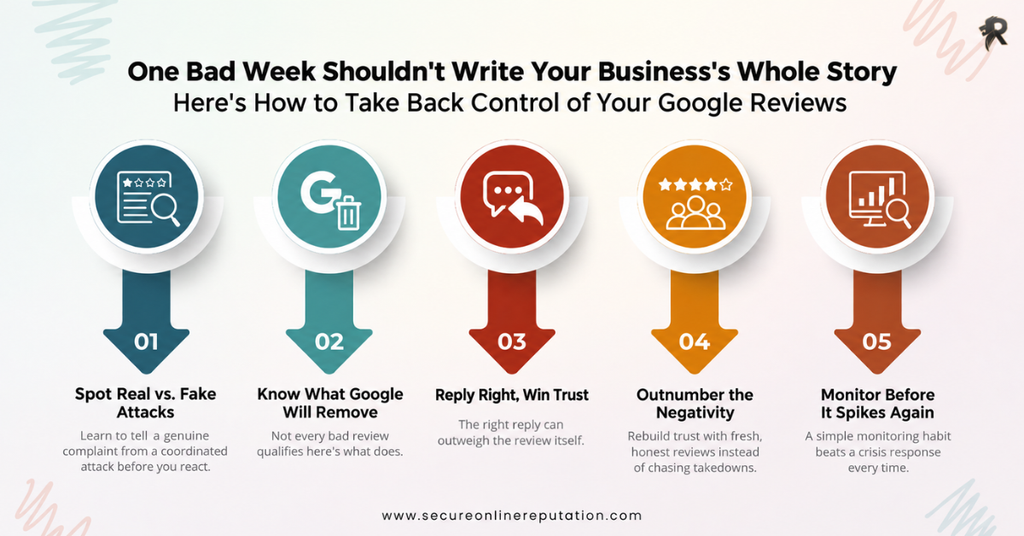
Before reacting, look for patterns. Check the timestamps, the language used, and whether the reviewers have any history on Google or any connection to your business at all. A wave of reviews posted within hours of each other, written in similar phrasing, or coming from accounts with no other activity is a strong signal of manipulation rather than genuine feedback. If the reviews violate Google’s policies — fake accounts, off-topic content, harassment, or conflict of interest — they can be flagged for removal. If they’re genuine but harsh, flagging won’t work, and suppression through response and visibility becomes the more realistic route toward how to remove negative search results tied to a coordinated attack.
3. How to online reputation management Search Results the Right Way
Google does allow review removal in specific circumstances, but only through its own reporting process, not through search engine support. A review is more likely to come down if it:
- Contains hate speech, threats, or harassment
- Is clearly off-topic or unrelated to an actual customer experience
- Was posted by someone with no verifiable connection to your business
- Violates Google’s conflict-of-interest or spam policies
Reporting a batch of reviews doesn’t guarantee they’ll disappear, and Google can take days or weeks to review a flag. This is why most people trying to remove negative search results quickly learn that flagging alone rarely solves the whole problem — it needs to run alongside a broader response.
4. What to Do When You Can’t Remove Negative Search Results Through Reporting Alone
Not every unflattering review breaks Google’s rules, and that’s exactly where most businesses get stuck. A review can be harsh, one-sided, or based on a single bad interaction and still stay up indefinitely because it doesn’t technically violate policy. In that case, the realistic path isn’t removal — it’s outweighing the review with a stronger, more current picture of the business.
5. Responding to Reviews Without Making Things Worse
Every negative review deserves a reply, even the unfair ones. A calm, specific, non-defensive response shows future customers — and Google — that the business takes feedback seriously. Avoid generic copy-paste replies; they read as dismissive and rarely help. A few things worth keeping in mind:
- Acknowledge the specific complaint rather than a vague apology
- Offer to resolve the issue offline when appropriate
- Never argue publicly, even if the review is inaccurate
- Keep the tone consistent across every response, good or bad
This step alone won’t remove negative search results from the page, but it does change how the surrounding content reads, which matters just as much once suppression efforts begin.
6. Rebuilding Trust After the Spike
Once the immediate wave has been addressed, the focus shifts to re-balancing the page. This is where fix my online reputation stops being a one-time task and becomes an ongoing practice. Encourage recent, genuine customers to leave honest reviews so the negative cluster isn’t the most recent activity on your profile. Update your business description, photos, and posts so the listing feels active and current rather than static. The goal isn’t to bury anything dishonestly — it’s to make sure a handful of reviews from a bad week don’t become the permanent first impression of a business that has otherwise been doing fine.
7. When to Bring in Professional Help
A single bad week, paired with steady owner engagement, is often manageable without outside help. But if the reviews are tied to a coordinated attack, involve fake reviews from unverifiable accounts, spill over into remove glassdoor reviews territory as employees pile on too, or the volume is simply too large to respond to manually, it may be worth bringing in support. Reputation specialists who work in online reputation management know which reviews are realistically removable, which need a public response strategy, and how to rebuild visibility around a damaged profile without wasting time on approaches that won’t move the needle.
8. Staying Ahead So It Doesn’t Happen Again
Once things settle, set up a simple monitoring routine rather than waiting for the next spike to catch you off guard. Check your Google Business Profile regularly, set up alerts for new reviews, and keep an eye on other platforms tied to your brand. Catching a problem within a day or two makes it far easier to manage than discovering it weeks later, once it’s already shaped how new customers see you.
Final Thoughts
A sudden increase in negative Google reviews feels alarming in the moment, but it rarely has to define a business long-term. Some of it can be reported and removed outright, some of it calls for a patient effort to remove negative search results over time, and the rest can be outweighed with a genuine, consistent response and a steady stream of current, honest feedback. The work isn’t about hiding criticism — it’s about making sure one bad stretch doesn’t become the whole story anyone finds.