5 Things You Can Do to Protect Your Online Reputation

With the advent of digitization in today’s society, it is extremely important to Protect Your Online Reputation, as it reflects how others view you from the very beginning. Irrespective of whether you are a working individual, an entrepreneur, or work within the organization, people will always judge you by what comes up in their Google search or social media platform.
Any negativity or misinformation about you could significantly harm your reputation. This is why services such as online content removal, online defamation removal, removal of negative news on Google, or negative search results removal have become necessary.
Below are 5 powerful, structured strategies to help you take full control of your digital reputation.
Table of Contents
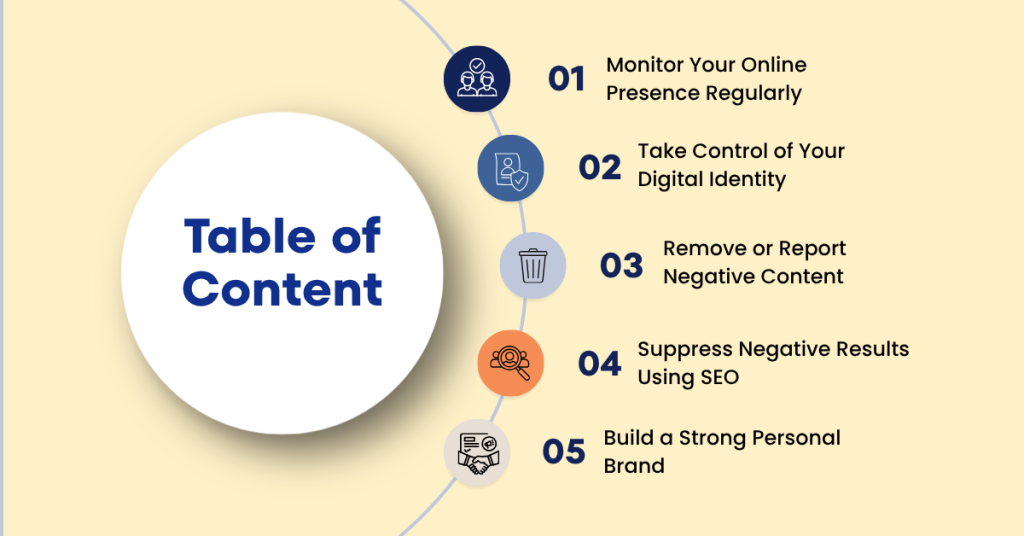
- Monitor Your Online Presence Regularly
- Take Control of Your Digital Identity
- Remove or Report Negative Content
- Suppress Negative Results Using SEO
- Build a Strong Personal Brand
Monitor Your Online Presence Regularly
One way to ensure that you Protect Your Online Reputation is through continuous monitoring of what is said about you online. Many individuals end up addressing the issue when it is too late, making it even harder for them to recover their reputation.
It would help if you start the process by conducting a web search of your name using any available search engine and analyzing the first pages that come up. You will get a sense of the digital impression others have of you. Additionally, you can set up alerts from sites such as Google, which will notify you whenever any information about you appears online.
Monitoring of social media websites is essential since you might receive tags or mentions that may affect your reputation.
Continuous monitoring is key, and it is recommended that you do it once a week or once a month. The earlier you detect problems, the faster you can address them. One significant benefit of monitoring is control.
Take Control of Your Digital Identity
The online identity is what comes up when a search is made about you. If the individual is not actively managing of their online presence, others will end up controlling it. The person needs to manage their digital identity and create an identity that they would want others to know about them.
The first thing to start managing involves the individual’s professional online presence. One needs to manage the information on such sites as LinkedIn. This is because it will showcase one’s successes in a given field. Updating the profile at all times will ensure that one finds something positive and true about you.
Social media also plays an essential part in building identity. The social media profiles should be reviewed from time to time to make sure that any content considered inappropriate, controversial, or unprofessional gets removed.
Managing your digital identity makes it hard for negative information to be known. It also ensures that positive and relevant information dominates your online presence.
Remove or Report Negative Content
There is no straightforward method to Protect Your Online Reputation than having bad information about yourself deleted as soon as possible. However, there is still a process for a certain strategy.
First, you need to understand what kind of negative content you have found. Is it misinformation, defamation in an article, or simply an outdated piece of information? Based on its specific characteristics, you will be able to take proper steps.
Many times, you can reach out to website owners and ask for deletion. Usually, they would not hesitate, especially if the information in question was false or misleading. In this case, you could use some legal measures, such as sending a proper request to the website owner.
However, it is crucial to realize that not everything can be removed from the web. For example, articles posted on high-quality websites or news sites cannot just disappear, no matter how much you try. When this happens, removing the content becomes irrelevant, and other approaches must be taken into consideration.
Understanding what can and cannot be done in terms of content removal allows you to make sound decisions regarding the most appropriate solution.
Suppress Negative Results Using SEO
Where removal of these search results cannot be performed, another approach is suppression. SEO plays a crucial role when you aim to Protect Your Online Reputation, especially when removal of negative content is not possible. It involves lowering negative search results so that they become less obvious to users when performing searches online.
As we have mentioned previously, search engines are always looking for relevant and quality material that should be featured on search results pages. You can help them do so by publishing positive information through blogs, articles, press releases, and professional information.
One of the key processes for achieving these goals is search engine optimization (SEO). By optimizing your online resources with suitable keywords, creating quality backlinks, and keeping your social media accounts and profiles alive, you increase the chances that positive information will come up in search results ahead of negative.
The point here is to suppress the negative information rather than remove it from the Internet. Most users do not scroll to the first page of search results, which means that the information pushed further down may go unnoticed by people who are searching for something related to you or your business.
With time, continued SEO endeavors create a significant digital footprint, which benefits you while reducing the impact of negative content.
Build a Strong Personal Brand
Creation of a strong personal brand can be termed as one of the best ways to Protect Your Online Reputation in the long run. Unlike always reacting to bad content, personal branding enables you to control the right path from the beginning.
Developing your personal brand requires you to continuously publish content that adds value to your industry. Such content may comprise articles, comments, participation in discussions, and even posting about your accomplishments.
The process must be continuous for you to establish yourself as an authority within your profession. In addition, continuous efforts make it easy for search engines to rank your content.
Interacting with your audiences professionally also goes a long way in protecting your reputation. For example, responding to comments and engaging with your followers are good practices.
A strong personal brand serves as a protection against any negativity. It is difficult for negative information to affect people’s perceptions when they encounter a positive online identity.
Conclusion
A strategy for maintaining a good online reputation needs to be a proactive and well-rounded approach. To protect your online reputation, monitoring keeps you informed, digital identity management gives you control, negative content removal tackles threats, SEO suppression reduces negative visibility, and personal branding establishes credibility over time.
Certainly, strategies such as deleting online content and dealing with defamation are critical, but these efforts alone are not sufficient. The key is developing a digital presence that will outshine any negative aspects by being more favorable.
In today’s digital world, your online reputation is one of your most valuable assets. Investing time and effort into managing it effectively ensures trust, credibility, and long-term success.
FAQs
1. What does it really mean to Protect Your Online Reputation in today’s digital world?
Reputation protection refers to a practice of managing how one presents himself/herself on the web in such a manner that his/her google search results and social media profile projects him/her in a favorable light. To Protect Your Online Reputation requires monitoring your name on the web, deleting any damaging information, and developing a good reputation for yourself.
2. How does online content removal actually work, and when should it be used?
Online content removal is defined as the process by which owners of sites, platforms, and search engines are requested to remove content that may be inappropriate or violate their policies. The approach is commonly applied to eliminate content that is incorrect, defamatory, and is eligible for deletion under the law. Unfortunately, it cannot be applied to many types of content.
3. What is online defamation removal, and why is it important for professionals?
Online defamation takedown means taking down defamatory or false information that has been made available on the internet. This is particularly essential for professionals since a single defamation may impact their career prospects and reputation. In many instances, legal intervention or the assistance of an ORM firm may be necessary.
4. Is it really possible to remove negative news from Google completely?
Yes, sometimes—although not necessarily always. In the case where the news article has been published by an authoritative or high-quality website, it might not be fully possible to remove it from Google. In such situations, other options can be pursued, like requesting updates or corrections to be made through certain policies. SEO techniques are also employed to hide the article.
5. What does it mean how to bury negative search results and how effective is it?
Burying negative search results involves ensuring that unfavorable or undesirable search listings are pushed to a low ranking by focusing on the creation of favorable results. The methods used include writing blogs, press releases, SEO optimization, and being active on social media. It is highly successful since most people only visit the first page of Google.
6. Can social media activity affect your online reputation?
Yes, social media is extremely crucial in helping you develop an online reputation. Anything that you have posted on your social media channels in the past could show up in the search results and affect your reputation.
7. Do I need professional help for online reputation management or can I do it myself?
Activities like tracking and maintaining profiles and social media posts can be handled manually. In cases where there are problems such as defamation, bad press, or malicious content with high ranking, it would be wise to seek help from professional ORM service providers. These professionals employ SEO and legal techniques that may not be easy to execute on your own.
8. What is the best long-term strategy to Protect Your Online Reputation effectively?
The most effective approach to take is a combination of all these actions – monitoring yourself on the internet, updating your content frequently, deleting or suppressing any negative content where possible, and developing a strong personal brand. This will guarantee that only positive content appears in search results.