How Chatbots and AI Search Engines Influence Your Online Reputation
When people reach out to you, it is possible that they have first searched your name, your business or your brand on the internet. Nowadays, it is also possible that they have used ChatGPT, claude ,Google Gemini, Perplexity or some other artificial intelligence search engine to give them an answer. The results that are found through such means can affect your online reputation within a matter of minutes. Something like a news article, a bad review, an outdated web page or just a misleading claim can generate doubts about you, despite the fact that these are not the whole truth.
This is precisely why it has become imperative to understand the workings of AI search engines to manage one’s online reputation.
Table of Contents
- How AI Search Is Changing Online Reputation
- What AI Search Engines Know About You
- Why Negative Content Can Affect Your Online Reputation
- How to Build a Strong Online Reputation
- How to Address Negative Search Results
- How to Push Down Negative Search Results on Google
- Create Content AI Search Engines Can Trust
- Monitor Your Online Reputation
1. How AI Search Is Changing Online Reputation
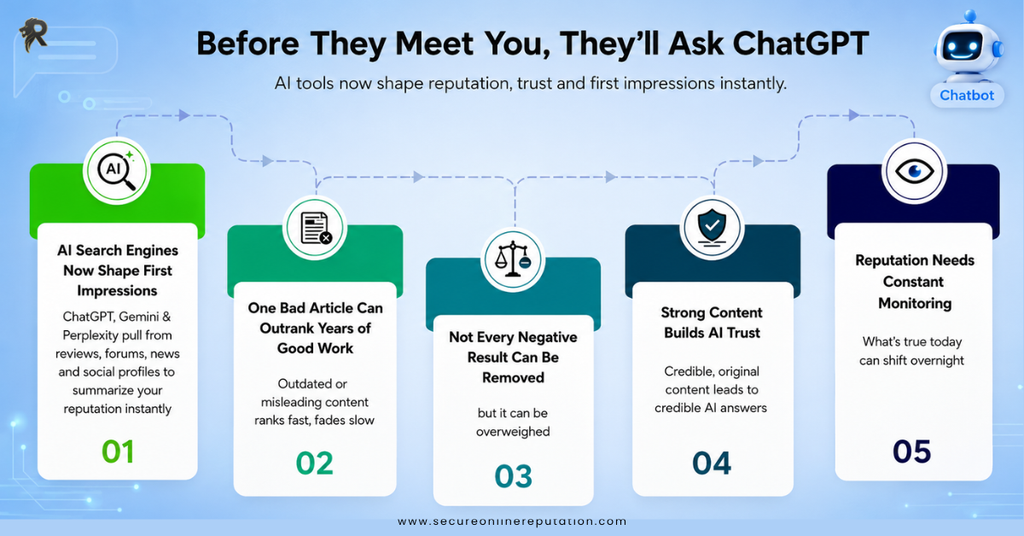
Typical search engines display a list of pages for a user to review. AI search engines gather data from various sources and present a summary straight away.
This affects the way people look up information on individuals or companies. People can ask an AI chat-bot questions like, “Is this company reputable?” and “What do people think of this executive?”
Such an answer could include references from news sites, company directories, reviews, social networks, forums, profiles, and other publicly accessible sites.
Nowadays, online reputation management requires more than just monitoring the first Google page. You should also know how your information is presented in the bigger search environment.
A good presentation builds trust. A partial or misleading presentation leads to mistrust.
2. What AI Search Engines Know About You
AI systems use information available across the internet to understand people, businesses, and organizations.
This information may come from:
- Official websites
- News publications
- Business directories
- Professional profiles
- Customer reviews
- Social media accounts
- Industry websites
- Interviews and podcasts
- Online forums
In cases where the reliable sources give consistent information, the search engines will get more relevant data about you and your skills.
An old and outdated article or even a web page that contains false information may come up when someone uses your name while searching online. This is especially a matter of worry when the web page ranks high or when it is cited elsewhere.
The solution for the executives and entrepreneurs could be through executive reputation management.
3. Why Negative Content Can Affect Your Online Reputation
Content that is negative will draw the attention of others as it may be precisely what they are searching for. The negative article, bad review, or complaint against an individual may keep coming up even when the situation has been resolved.
Search engines do not take anything to be the truth just because it is available online. Similarly, no system can independently verify everything found online.
Nevertheless, the information which stays on credible sites or those highly relevant can impact the kind of information people find about you.
It is for this reason that managing one’s online reputation needs more than reacting to the issue after the event occurs.
4. How to Build a Strong Online Reputation
A strong online reputation starts with a clear and accurate digital identity.
Begin with the platforms you control. Review your official website, professional profiles, business listings, social media accounts, and industry pages.
Make sure they contain:
- Accurate contact information
- Current company details
- Clear service descriptions
- Professional biographies
- Relevant experience
- Recent achievements
- Helpful educational content
You can also publish original articles, expert insights, case studies, interviews, and useful guides.
The purpose is not to flood search results with repetitive pages. Instead, create valuable information that answers real questions and demonstrates genuine expertise.
For businesses facing serious reputation concerns, business reputation repair may combine content creation, search optimization, profile improvement, monitoring, and legitimate content-resolution efforts.
5. How to Address Negative Search Results
Many people begin searching for remove negative search results after discovering an unwanted page.
The first step should always be understanding the source.
Ask:
- Is the information accurate?
- Is it outdated?
- Does it violate the website’s policies?
- Can the publisher correct the information?
- Does the search engine provide an applicable removal process?
If information is false, outdated, or violates a platform’s rules, contacting the publisher may provide a solution. Depending on the circumstances, a search engine’s own removal process may also apply.
However, not every negative result can be removed. Legitimate reporting, criticism, and opinions may remain online.
When direct removal is not realistic, improving the rest of your digital presence can help provide a more complete and balanced picture.
6. How to Push Down Negative Search Results on Google
When an unwanted result cannot be removed, people often ask how to push down negative search results on Google.
Search-result suppression focuses on strengthening legitimate pages that deserve visibility for searches related to your name, business, or brand.
Useful content can include:
- Expert articles
- Company news
- Industry interviews
- Professional profiles
- Educational resources
- Case studies
- Business listings
- Original research
The goal is to create credible pages that search engines can understand and users can trust.
This process takes time. Google considers many ranking signals, so nobody can honestly guarantee that a particular negative page will disappear from a specific position overnight.
A thoughtful strategy focuses on quality, relevance, authority, and consistency.
7. Create Content AI Search Engines Can Trust
Content has become an important part of building a strong online reputation.
AI search engines need reliable information to understand people and businesses. When your website clearly explains your expertise, services, achievements, and experience, you provide useful context for both search engines and potential customers.
Focus on creating content that is:
- Original
- Accurate
- Helpful
- Easy to understand
- Relevant to your audience
- Supported by credible information
Avoid publishing low-quality articles simply to occupy search results. Poor content can weaken trust instead of strengthening it.
If you are comparing best online reputation management services, look for companies that use realistic strategies rather than making unrealistic promises. Effective reputation work may involve monitoring, content development, search optimization, and legitimate removal opportunities.
8. Monitor Your Online Reputation
Your online reputation could always be altered in any instant.
There will be a new review or article or something posted on the social media sites that could alter what people find out about you.
Constant monitoring helps you know about any problem that may arise.
Check searches involving:
- Your full name
- Business or brand name
- Executive names
- Products and services
- Common name variations
- Industry-specific terms
It is also useful to check how different AI search tools describe your business or professional identity.
If an AI-generated answer contains incorrect information, investigate the sources behind it. Improving those underlying sources may help create a clearer and more accurate digital presence over time.
Final Thoughts
The use of chat-bots and artificial intelligence (AI) search engines is altering information searching behavior. Individuals no longer need to look at several web pages for themselves but can simply have the AI system give them information it has about a particular individual, business, or brand. Having a good online reputation has never been more vital. In case you realize any undesirable information on the internet, you should first determine where it comes from, if there is any possibility for corrections and removal. Where such an option is not feasible, make sure that you are building useful and credible content about yourself. Creating a reputable digital image is a process that requires time and effort. By managing the information which you are able to control, you can create an online reputation that speaks of you.